
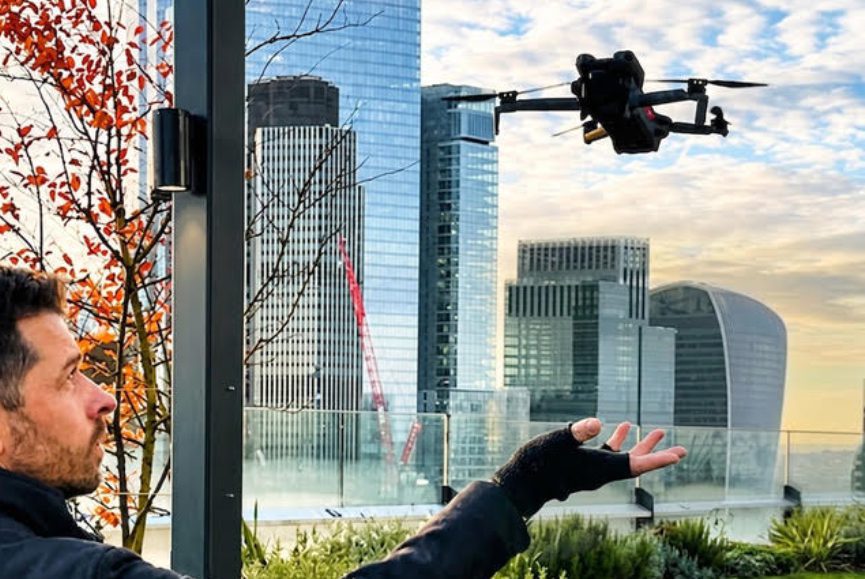
(Photo: Jake Mobbs
In the latest in our series of interviews with London-based freelancers, we speak to freelance drone operator Jake Mobbs.
Based in Twickenham and working across Central London, Jake shares how he built his aerial photography and cinematography service, what freelance life looks like day to day and why seagulls can be an unexpected workplace hazard.
Jake, could you start by describing your service?
I run an aerial photography and cinematography service, giving clients high-res videos and stills from hard-to-reach areas, especially around Central London.
What first inspired you to become a freelancer, and how did you get started?
For me, the main draw to freelancing was the variety of projects. In the times that I was working in-house, my day-to-day routines were almost always the same. Freelancing gave me the chance to very quickly develop close relationships with lots of different agencies and different directors, in all kinds of working environments.
What kinds of clients do you typically work with, or have you worked with over the past few years?
Typically it’s either architecture and construction or brand-funded social content. It can be quite a range, as drone work covers almost all industries – even if it’s just to put a nice aerial video on a website.
What does a typical working day look like for you?
Now that I do drone work, my day is often spent prepping jobs, writing risk assessments or planning flights. If I’m filming, it’ll involve travelling to the shoot, working with the client to capture cinematic shots or photography and then running it through some post – colour grading or clipping the best shots, and uploading. There’s also the nitty gritty side, calling the MET police to get clearance, and battling seagulls that want to crash the drone.
Do you work with any clients remotely and do you travel much for work?
The flying is all on-site, but everything else, the pre-production planning, risk assessments and permit applications, is remote, plus any post-production. Most of my projects are in Central London, so there’s not a lot of travelling.
How do you usually go about finding new clients or opportunities?
This is both a strength and a weakness. My website does most of the work, so people find me and request to book me. I’m quite useless at making calls and reaching out to new clients, but this is something I’m keen to work on. I currently have no control over who finds me, but at least I can pick and choose who I call and email. There are so many great clients I’d love to work with, I just have to sit down and make that call!
Have there been any challenges in your freelance experience so far and, if so, how have you dealt with them?
The hardest challenges are normally when you end up covering too many roles. For me this could be camera operating, pre-production producing, directing and editing, all for one daily rate. When you work in-house, you’re usually surrounded by a solid team and you focus on your speciality. Unfortunately, as a freelancer, you can end up doing it all, plus the admin after the shoot. Depending on the project size, it can be overwhelming.
How do you maintain a healthy balance between work and personal life?
Have strong boundaries with clients, so you don’t burn out. Make it clear what your limitations are. Try and operate with a day rate, not a project rate, so that you don’t feel like you’re tied in 24/7. Meet up with friends or colleagues in the same industry, so that you’re networking but also getting out and off the screen. Also, try and shut down the computer around 5 or 6pm, as you would in an office, when possible.
Which neighbourhood are you based in and does it feel like a good area for freelancers?
I live in Twickenham, which is great if you want to get out of the city but stay well connected. But for a lot of freelancers, I think East London is still the best option.
Finally, what are your three favourite spots in London?
Chinatown, Richmond Park, Southbank.